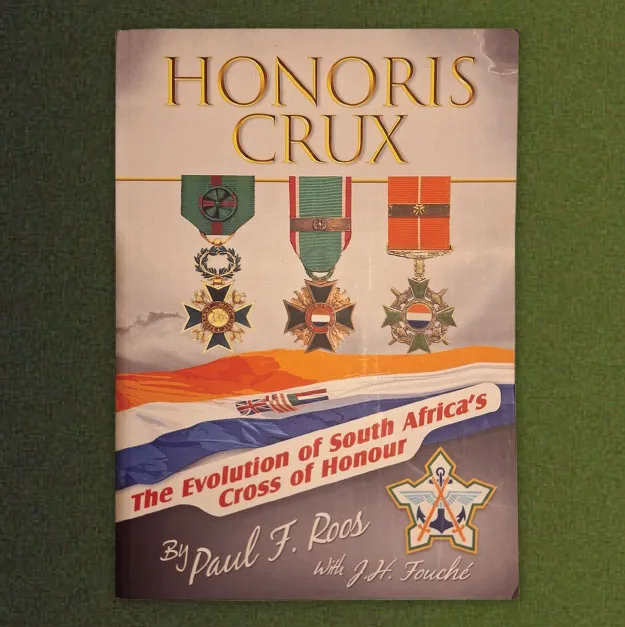
Honoris Crux: The Evolution of South Africa’s Cross ofHonour by Paul Roos appeared in 2023, and covers the period from 1973 (when the first HC of the 1952 series was awarded) to 2004 (when the last HC was awarded). Reference is also made of the new bravery awards of the South African National Defence Force (SANDF), i.e. the Nkwe or Leopard series for bravery. Prior to Honoris Crux, Roos also published Pro Patria Medal: Types, Variants, Ribbon Accoutrements and Selected Recipients of Interest443 in 2021. This medal was part of the 1975 series and was awarded as a military campaign medal from 1974 until 1989. It was subsequently replaced, first by the General Service Medal as campaign medal, and then discontinued in 2003, to be replaced by the Tshumelo Ikatelaho medal for internal and external military service.
Honoris Crux is a book that will appeal to all serious medal collectors as well as military enthusiasts. The purpose of the book is not so much to highlight the deeds of heroism, which resulted in the award of the HC, but rather to fill the void in the reference material pertaining to the evolution of this decoration. The significance of the book lies in the extremely thorough archival research that was done in terms of all aspects of this decoration, as well as numerous interviews with recipients. Every detail of this specific decoration is discussed at length. The HC can be considered the South African equivalent of the British Victoria Cross, or the United States Congressional Medal of Honour. The 1975 series of the HC, which replaced the 1952 series, was graded into four classes: the HC Diamond (never awarded), the HC Gold (awarded six times), the HC Silver (awarded 28 times), and the standard HC (awarded 199 times).
Honoris Crux contains numerous colour as well as black and white photographs, which highlight the different variants of each class of the HC. Many tables are also found to indicate all the recipients. In some instances, short summaries are given of the citations for awards, indicating where, when, and for which actions an HC was awarded. A good balance is maintained throughout by the way the history and evolution of the award and the supporting photographs – many of which are published here for the first time – are presented. Roos narrates the history of the HC decoration from a third-person’s perspective, however, lapses now and then into the first person. A number of technical errors occur throughout the book with regard to the naming of units and political parties. There is also repetition of some of the literature and photographs; however, this does not diminish the good work that has been done in terms of research.
Although the book is not arranged in clear chapters, it can be roughly divided into eleven parts. The first part introduces the reader to the HC decoration, and describes the origins of the medal, which date back to 1894, when the president of the Zuid-Afrikaansche Republiek (ZAR), Paul Kruger, proposed the establishment of a system of honours for the Boer Republic.444 This is followed by the history of the institution of the 1952 series HC, of which only five were awarded between 1973 and 1974 in the SADF. The next four parts cover the different classes of the newly instituted 1975 series HC that replaced the 1952 series HC, and describe in detail the award criteria, technical details of the award, as well as selected recipients of the award. Of interest is the section dealing with the variants in certificates and the boxes or packets within which the HC was issued. There is also a photographic library of all the confirmed numbered HCs, as well as a section on inconsistencies and anomalies in terms of the award. Three recipients were decorated twice with the HC, and seven recipients have been decorated with the HC and similar military awards for bravery. Being the recipient of a multiple bravery award is an outstanding achievement; hence, parts eight and nine list these recipients and the actions that resulted in them being decorated so. In part ten, the largest single action for which the HC was conferred, is described.445
The last part of the book provides interesting facts about the award, such as which units had received the most HCs, who received the wrong class of the HC, and that all the HCs awarded to members of the South African Navy were for deeds of heroism in non-combat roles. It also highlights the institution in 1987 of the Service Cross series446 and how the HC and the Service Cross series were discontinued by the SANDF in 2003 and replaced with the Nkwe or Leopard series for bravery. Photographs are favoured over the written word in all parts of the book, and this is where the strength of the book lies. Honoris Crux is not a book for reading in the traditional sense of the word, but rather for studying the vast number of photographs. Roos argues that the history of this prestigious decoration serves as an example of how symbols, such as medals and decorations, reflect the changing political and military circumstances of a country. This is clearly highlighted in the South African military history also, as described by Roos in the book.
Honoris Crux is an important contribution to the historiography of South African military medals and decorations, particularly the Honoris Crux, to which the book owes its name. The book further emphasises that bravery does not know colour, race, or politics, and that it is important that those who have been awarded the highest military award for valour, especially those who have made the ultimate sacrifice, should be remembered and their deeds celebrated, regardless of the political period in which the award was bestowed. One can only hope that Roos will see his way open to publish a similar book on the Service Cross and Leopard series in the future.